ANGELOS RODAFINOS, PHD
  • Home
    • What's inside
  • Books
    • Idiots (UK/GR/BG) >
      • Idiots GR
      • Audio book
    • Frogs >
      • Frogs GR
    • Critical Thinking GR
    • Reader comments >
      • Post your comment here
  • Training
    • Topics >
      • Personal and professional development
      • The psychology of change
      • Critical thinking
      • Customer service
      • Management
      • AI Training
    • Testimonials >
      • Post your comment here
    • List of Clients
    • Past Events
    • Organize an event
    • Photo Gallery
  • Consulting
    • 1. AI tools >
      • AI tools for the office >
        • Εργαλεία ΤΝ για το γραφείο
        • Εργαλεία ΤΝ για νομική
      • AI Tools for Hotels
    • 2 Curriculum and course design >
      • App v1. Audit and Update your Curriculum with Z.ai
      • App v2. Audit and Update your Curriculum with Deep Seek
      • App v3. Audit and Update your Curriculum with AI studio
    • 3. Course Improvement Playbook
    • 4. Plagiarism
    • 5. Student and staff support
    • 6. Work from anywhere
    • 7. Critical thinking
    • 8. Mental skills training
  • Free stuff
    • Articles
    • Blog
    • Apps >
      • The SentimenTable
      • The Ro Method
      • Behaviour Change Contract
      • Do the right thing
      • ChatBots
    • Online Courses >
      • AI tools
      • Critical thinking
      • Idiots are invincible >
        • Part 1
        • Part 2
    • eBooks
    • Videos
    • Podcasts
    • Presentations
    • Free posters - Idiots >
      • Free posters - Frogs
    • Links
  • About Dr Ro
    • CV for not so serious visitors
    • CV for serious visitors >
      • Research interests
      • Character references
    • Fee Schedule
  • Contact

Part 2 - Idiots are invincible: A short course

Picture
In this section we will explore specific applications of the Ro method in selected scenarios (a small number of the many presented in the related book). 

Don Stressote, a modern-day Don Quixote and a Ro method graduate, will serve as the model, altruistically putting himself to the test during the course of a day. 
We will observe how Don applies the theory you have been reading about in Part 1, keeping in mind that there are only two options when dealing with a situation: 
  • to accept the responsibility to change it or 
  • to change the way you see it. 
Well, I guess one can also be creative and a little eccentric occasionally when responding to a stressor.

Having mastered the learnings of the previous chapters, Don will face signs and wonders, maybe even… blunders, but will come out smelling like a rose. 
He will successfully fight road traffic, confront annoying others (drivers, managers, colleagues, clients, friends and relatives), and deal with perhaps the most difficult person of all: himself and his irrational thoughts!
Let us spend a day with him. Move on Sancho Panza, watch and learn!
 
Dr Ro

(Don Quixote clipart: izakowski/yaymicro.com)
​(Cartoons: Dr L. Lazouras, K. Papantoniou)
8. Morning work-out

Welcome back!

As promised, we will spend some time in the company of Don Stressote. The sun has risen, let’s start the day.

Many people complain about the conditions in their life, often with good cause. “How can I be happy in the morning when …” and they describe what is happening to them.

While having breakfast, Don picks the morning newspaper, and applies an old technique, invented by Og Mandino. He flicks through the pages and scans the obituaries. If his name is not listed there, he figured, he has every reason to be happy! Some others were not so lucky today. He is confident that the deceased would give … well, their lives if they could change places with him! 

"No one is indispensable … that is why the graveyards are full!" – Charles de Gaulle

My good friend Jim Papanikolaou once said, “Not only would I give everything I own, I would even work 10 years for free for them [the Father, the Son, and the Holy Spirit].” He should know; he suffered leukaemia a few years ago - and survived. 

Don takes a deep breath and exclaims with enthusiasm: “It’s a wonderful day to be alive!” 
If you disagree, try missing one ...

Perspective
Putting things in perspective is a very useful technique, which we described earlier, particularly if there is not much you can do to change the conditions.
Your situation may be difficult, but it could be worse. I hope you are not incurably ill, you are not serving life imprisonment, and that someone – just one person, your dog, your pet canary or the jasmine plant on your balcony – still loves you.  

Exercises
  1. Who loves you? Make a short/long list and read it frequently. Make sure you pass some love to them too. If they look at you with suspicion, explain “it’s doctor’s orders”.
  2. Examine what you can do to change the things you find unsatisfactory. Start with the first thing that annoys you when you wake up. Reminder: use the “Ro” method. E.g., if it’s your alarm clock, change the tune to Vivaldi’s spring. If it’s your thoughts, change them. If it’s your partner ... well, you figure that out yourself.

On the way to work
Having enjoyed his breakfast, Don is on his way to work. He smirks as he thinks of a research study he read recently. Research participants who were asked to hold a pencil with their lips (frowning group) evaluated the same cartoons as less funny compared to a second (smiling) group, participants who held the pencil with their teeth. 

What’s the explanation? According to the “facial feedback” hypothesis, facial muscle movements send relevant messages to our brain neurons. It appears that our facial expressions provide our brain with information related to our mood. Frown or smile and the emotion will follow, concluded Don!

Application: act the part
To experience a particular emotion, act accordingly – as if you have already felt it. Do you want to feel enthusiastic, energized, and happy? Act enthusiastically and joyfully. Your turn to test the theory. Start small, by changing your posture. If you are sitting, sit up straight. If you are standing, take a deep breath, and push your shoulders back. If you are walking, stride with a dynamic and assured gait. Feeling better?
Wait, there is more! 

Greetings and salutations
Exchanging conventional greetings can be monotonous and dull. In this peculiar area of human behaviour, one can be formal and ordinary or choose to be slightly eccentric, without people getting the wrong impression – much. Here are some creative salutation options:
  • “Hello.” -“Yellow!”
  • “Good morning.” -“Isn’t it just!”
  • “Hi!” -“Very high!” etc.
Don has tested the drill. He can assure you that the other person will either crack a smile after Don’s creative salutation or stare with a puzzled expression that makes Don crack a smile.

Your turn again. Check out the Sentimentable app. Follow the instructions, pick your random word, and use it to great people for the rest of your day. Study the reactions of those you greet. Be prepared to explain the theory behind the drill - if you are interested in what they think about you.
We’ve just discussed a few ideas that may help you change the way you start your morning.

Tomorrow we’ll explore some more. It gets better. We’ll discuss creative responses to anger.

To an Idiots-free Day!
Dr Ro
​
Recommended book
Don't Sweat the Small Stuff and It's All Small Stuff: Simple Ways To Keep The Little Things From Taking Over Your Life
Picture
It’s a wonderful day to be alive!
9. Angry drills
Welcome back!
You have learned a couple of simple tricks to change the way you (and others) feel during the morning. Today, we will learn a few more.

S&M rubber drills
This exercise will help you become aware of how often negative thoughts evade your mind on a daily basis. It will also prompt you to dust away unwanted thoughts or change them to more positive ones. Here we go.

Don wears a rubber band on his wrist, like the ones Mr Albert the grocer uses to wrap the feta cheese you buy. Chic women can wear branded Lacoste, Armani, and Bridgestone rubber bands, to keep up with their style.

During the day, every time Don catches himself contemplating negative or pessimistic thoughts, complaining, getting irritated etc., he stretches the rubber band and lets go suddenly so it returns to its initial position, thus whipping and punishing his wrist - in a sadomasochistic kind of way.
Watching his wrist turn red after a while, he realizes just how often many unsavoury thoughts unsettle his otherwise moral and calm life on a daily basis.

Exercise
To complete this day’s first exercise, you need to put on your wrist the required accessory. Find a rubber band on your size and wear it now. 
Record the number of occasions you “punish” yourself during the day, for a few days. Aim to reduce the incidents during the course of the week. Engage in a competition with a buddy of yours, and set a symbolic prize for the winner.
Alternatively, if you are not into S&M, use a stopwatch to count how much time you spend per day in an angry or negative emotional state. Then, examine your thoughts. Aim to change them and reduce this time by 20 or 30% per week.
Picture
Given the seriousness of Don’s condition, the doctor recommended the S&M-2020, a more advanced and therapeutic self-punishment model compared to older rubber band prescriptions

​Anger management 
Our next subject of today is closely related to the first one. 
Do you often become upset? Very upset? What or who infuriates you? Let me guess: other people. Why? Under what circumstances? 

To deal with anger, we first need to explore the foundations of anger. Anger is based on the following three sentences:
  1. Why don’t others behave the way they should? This type of anger is directed towards others. “Should” can be interpreted as “the way they are supposed to” or “the way I would like them to.”
  2. Why don’t I do what I should do or why don’t I get the results I ought to? This kind of anger is directed inwards, towards the self. “Should” refers to what my beliefs or others want me to … want.
  3. Why isn’t the world the way it should be? Anger in this case is generic, directed towards everyone who is “responsible,” known or unknown. “The way it should be”, in this case, is quite abstract. People can set their standards as high as they like. The only problem is that the higher our standards are, the easier it is to feel dissatisfaction or injustice.
Here are a few simple thoughts that may help you manage your anger a bit better.
  • Anger is a thought you carry along with you. 
  • It’s not what you say or do what makes me feel bad, but rather what I do with what you say or do. (M. George)
  • When someone throws the ball to you, you don’t have to catch it (A. Robbins). 
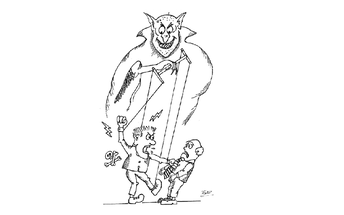
Mull over these ideas for a while. Examine their validity. Test the latter idea next time someone throws you a bitter comment. Don’t catch it! Don’t let others pull your strings. Remember, it is your thoughts that offend you. Remove judgment and you remove emotions. 

I know, it’s not that easy. It requires some training. Here is a useful technique. 

Time out
In the beginning and until your responses become more automatic, do not hesitate to ask your “opponent” (i.e., the idiot who dares to disagree with you) for a time out. Suggest a cease-fire for a certain period and continue the argument exactly from where you left it. Don takes a deep breath and counts to 10 (thousand). Then consider whether there is a small chance you might be wrong or unable to see the other side of the argument. Normally you are 100% right in everything, but, you know, maybe you could be the one who is wrong this time? 

Tomorrow we’ll continue along the same lines, and present a couple more tips on how to deal with annoying others and your own annoying thoughts. 
​
To an Idiots-free Day!
Dr Ro

Recommended reading
Ch14 Anger Idiots are Invincible by Dr Rodafinos.pdf [28 pages]
Anger Management For Dummies
Picture
10. Work drills
Welcome back!

Yesterday, you learned a couple of powerful thoughts that can help you deal with your own anger. Today, we’ll present two more ideas, one of which can be applied at work to deter colleagues who tend to whine and grine.  

The Stress-Visa
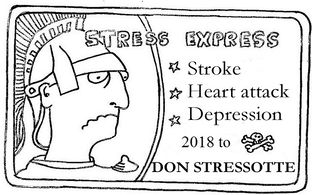
Allow me to introduce yet another visa card, the Stress-Visa (S-Visa) with instructions on both sides.
Side A of the S-Visa answers the question “What can happen to me when I am stressed out.” It lists some of the deleterious effects of stress on our psychological and physical health. 
Side B includes a number of prompts, aiming to remind the owner to change his/her thinking and reduce stress swiftly and effectively:
  • How is this behaviour helping me accomplish my goals?
  • Can I do something right now, or should I accept the situation and focus my energy on something else?
  • Relax. It is not worth it.
  • Imagine the enemy in red long johns.
  • You will make it. You always manage to overcome everything … eventually!
  • In two years from today, this event will have absolutely no importance. 
Or any other such soothing comment.

Don was kind enough to explain how to use it:
  1. Every time you catch yourself mulling over the difficulties at work, or worrying in advance for a future event, pause for a second. Pull out the S-Visa and read aloud the list of the effects of stress on side A. Next, take a couple of deep breaths (they are free of charge: “Ahhhh” and “Ahhhh”), smile discreetly, and tell yourself: “Everything is fine. Cheer up you old codger. Just smile. All is cool.” 
  2. In emergency cases, turn the S-Visa over and review side B. 
It works! Trust me, I'm a doctor. 

Porky the miserable
The following drill aims at reducing grumbling and complaining at work.  
Step 1: Buy a fat pink piggy bank.
Step 2: Appoint a Grouch Officer (G.O.)
Step 3: Every time a colleague says something in a negative tone, complains or grumbles (about the weather, the traffic, irate customers, etc.), the G.O. books the offender who receives a Grouch-Ticket (G.T.) and is required to deposit two Euros (Dollars, Pounds, Yuan, Yen – pick your currency) into Porky the Miserable, the fat pinkish piggy bank.
Step 4: At the end of the week, Don and I will join you and go shopping for carrots and cucumbers with the money collected through the fines. We will have a feast and drink to the health of the grouches. If the office is a multi-grouch station, we can invite relatives, neighbours or the mayor and the city council to the festivities.

The more you complain the longer God lets you live [to suffer, that is …!] – Anonymous

Exercise
Your turn now. Don’t just read and smirk. Try Porky at work. I suggest you start small - test it for a week first. Then, if you want to go all the way, add this extra rule: in case of relapse or recurrence, the fine doubles. Note: You may need to organise POS/credit card payments as well, because a person fined a dozen times on a single day will have to pay €2,048. Fines for two dozen misconducts amount to €8,388,608.

Before we close the day, here is a bonus technique. 

Isn’t this interesting?
​Next time an “Idiot” upsets you, tilt your head on one side, smile, and shake it from left to right, saying out loud: “Isn’t this interesting?" Then, try to see the other person's perspective rather than getting tense and uptight. 

Join me tomorrow as we follow Don return home after a great day at work. He’s got a few more tricks under his sleeve. 
To an Idiots-free Day!
Dr Ro

Recommended reading
62 Stress Management Techniques, Strategies & Activities
Picture
11. ON THE WAY HOME
Welcome back!

Yesterday, we presented two useful techniques, the Stress-Visa to help you manage excessive stress and Porky to help you manage professional complainers. Today we will discuss a couple of techniques for those who want to lose weight, as dissatisfaction with one’s image can be a significant source of stress. Best to read the text below at the end of your work day. 

Don, our hero, is about to pack up and leave work. Another day in his work life is coming to a close. 
What about yours? Was it a good day? 
If not, you may feel like visiting the local patisserie on your way home. We need some pleasure, after all. 
Well, I have terrific news for you: 
Cakes, sweets, and sugar do not build up fat!
Yes, you heard me right. These do not build up fat …
YOU do!

“It’s not my fault I am fat. Flying cheesecakes land in my mouth, and I swallow them unwittingly,” some utter as an excuse for their weight. 
​
Not true. We choose everything we eat and we can normally control what we choose. Except, visual stimuli and the aroma of food can defuse the strongest will, particularly in the evening. Much like a muscle, our will power is depleted at the end of the day. Even Don can’t say “no” to freshly baked cakes when they beckon him provocatively. The following ideas may help you. 

Tip 1. First diet your house. Warning! Most of the food you have in your house will eventually end up in your stomach. If you wish to lose weight, watch your purchases e.g., from the supermarket and ensure you also ask your friends and relatives for their support: 
“Dear mum, if you really love me the way you say you do, please don’t fill up the house with sugar and other unhealthy foods.” 

Tip 2. Change your route. If you have trouble saying “no” to treats, alter your normal route. Avoid passing near bakeries and fast-food restaurants. You will significantly reduce the likelihood of running into ambushes by ground-to-mouth-to-stomach flying cheesecake or hamburger missiles.
As Jim Rohn puts it “We must all suffer from one of two pains: the pain of discipline or the pain of regret. The difference is discipline weighs ounces while regret weighs tons.” He adds, “Something that tastes sweet in the mouth might turn bitter in the belly.”

Nothing tastes as good as being thin feels! – Elizabeth Berg

The advice about dieting and losing weight is endless. Remember, the basic rule is that to maintain your body fat, you need to ensure that intake equals expenditure. To reduce it, ensure that intake is less than expenditure.
 
Commitment devices 
Here is your usual bonus technique - one of my favorites. Keeping up with new findings and new technologies, use a “commitment device,” a tool that holds you to your promises. Download one of the many “Virtual nagging wife” or a similar “Nagging husband” app. You can select a photo, the hair colour, voice, text, and your spouse’s avatar will pop up at key times (e.g., before lunch) to remind you “Watch what you eat honey, you did promise to lose weight, didn’t you. I love you.”

The truth is that, much like Aesop’s fable about the goose and the golden egg, if you wish to sustain your ability to produce, you need to make sure you nourish and take good care of the producer, that is, yourself. 

If you want to accomplish your goals, and enjoy the process, best to engage in energy- rather than time-management. it is essential that you have the required energy and vitality during the day. 

For this purpose, I suggest you check your path and examine your daily habits. Are you heading where you want to go or where you do not want to end up? Look for inconsistencies in your values and your everyday behaviour. E.g., you may value health but you smoke; you want to get a good degree at the university but you spend hours on social media, TV or playing computer games. Make sure you line up your ducks.

Tomorrow, we’ll spend some time discussing the need for continuous self-development, as the key to better relationships, health, finances, life satisfaction, less stress and many more. 

I’ll see you then.

To an Idiots-free Day!
Dr Ro 

Recommended book
How to Eat, Move and Be Healthy
Picture
Really? Cakes do not build up fat? What a relief!
​12. Continuous self-development
Welcome back!

Yesterday, we discussed how our dissatisfaction with our self-image, using being overweight as an example, can have a spillover effect onto other areas of our life. Today, as we are approaching the end of this brief course, we will continue along the same line to emphasize the need for self improvement and offer a few suggestions on how to accomplish exactly that. 

If you wish to get more from life (e.g., money, material goods, relationships, health), you must make yourself more valuable, argued Jim Rohn. Because, your rewards in real life depend on what you have to offer to the market place and on the value you bring to the community.

Study to increase your expertise and skills around your profession, but also to build your knowledge of human behaviour, and the ability to understand your fellow human beings. Work on communication, relationships, dealing with conflicts, delegation, goal setting, and time management skills. 

A simple strategy is to surround yourself with people who are smarter than or as smart as you are. As they say, if you want to fly with the eagles don’t hang around with the turkeys. 

Ultimately, hang out with people like our hero, Don, and with role models whose characteristics and behaviour you admire and wish to adopt.

The future belongs to the competent. Well-read and knowledgeable individuals have more and diverse professional choices and are socially more appealing.

People can acquire everything they desire (always within their genetic limitations and within reason) provided they are willing to work for it. If you really want something, and you are prepared to pay the price for the ticket that will lead you there, then go for it!

Develop your own plan
To get more out of life, it is time to figure out your own self-improvement strategy.
As Dan Silvestre suggests, start by creating a two-column list:
  1. On the left, consider the areas that are important to you and write down the skills you need to develop in order to reach your goal.
  2. On the right, list the tasks and behaviors you should be doing on a daily basis that will help you develop the skills you listed on the left.
Once you manage to write down a few items, rank these in order of importance. Which 2-3 of these activities will yield the highest return and lead to major improvements in your life? 
Here are a couple of examples:
  • Life satisfaction: stress management skills. Read more on the subject, watch related videos, MOOCs, TED talks etc. Half an hour a day, before breakfast and after dinner… with a glass of water. 
  • Relationships: communication skills. Attend a related course, learn about conflict resolution, see a counsellor. Monday and Wednesday afternoons.
The list of things you can do to improve yourself is endless. Yet, there is no need to do everything at once. One step, one skill at a time. 

Also keep in mind that things will not always go as you anticipated or planned. Setbacks, problems, and diseases are part of life. Ah, but the good thing is that tough times and bad experiences can often teach us valuable lessons! So, when you lose make sure you don’t lose the lesson. 

Keep on track and ensure you make the right choices, choices that will eventually get you where you wish to go. Complete the little errands, pick up the phone and call a friend, read to the kids, give a loving hug to your partner (and whatever may follow). 

A slightly different week, in the company of Don Stressote, has reached its end. What have you learned? What changes are you prepared or determined to make? What will you not do again? What will you do differently?

Attention though. As Ziglar colourfully pointed out, “If you keep on doing what you’ve been doing, you’re gonna keep on getting what you’ve been getting.” If you change nothing, nothing will change. Well … not entirely true. Things will change even if you change nothing – probably for the worse, because, if nothing else, none of us is getting any younger! (By the way, the older you get, the better you realize you were …).

Tomorrow, we will recap everything we learned throughout this course. I will provide you with a few reminders and a bonus tip, as usual.
​
To an Idiots-free Day!
Dr Ro 

Recommended book
Atomic Habits: An Easy & Proven Way to Build Good Habits & Break Bad Ones
Picture
If you want to fly with the eagles don’t hang around with the turkeys.
​13. The beginning (epilogue)
Congratulations! You have reached the end of this course - or, you have reached the beginning of a new period of your life!

So, what did you think? I hope you enjoyed the content and the experience. In fact, I hope you enjoyed all or most of your total experiences so far. Why? Because the present soon becomes past and is gone forever. For that reason, make sure that you make the most of your precious time on this planet. Put things in perspective and do not blow them out of proportion. View your work (and your life) as it really is or … better than it is. Appreciate the positives and learn from the negatives.

Let’s summarize the lessons on stress management and problem solving, and review some of the tips by Don Stressote. 

Stress. Stress can be useful or harmful. A certain degree of stress is necessary - it provides alertness, variety and serves as a comparison standard. Excessive stress is the problem, as it can be detrimental and deleterious to our physical and psychological health. We need to learn how to regulate our level of stress - and that is completely possible. We can enhance our coping skills and use a number of techniques to effectively deal with excessive stress.

Coping with stress. All individuals face challenging situations and serious issues. Our perception, interpretation and responses make the difference and determine how successfully we cope. Unwise and maladaptive responses to stressors may feed negative emotions, such as worry and apprehension, are predecessors to unhealthy behaviours (e.g., smoking, poor nutrition, insufficient rest), and increase the chances for further psychological and physical problems. Yet, we can control our thoughts, our emotions and our responses. As Seneca put it, "Pain is inevitable … suffering is optional." 

The “Ro” method. I believe by now you have figured out the basic choices in dealing with all types of problems: a) accept the situation as it is or b) accept the responsibility to change it. According to the “Ro” method, when presented with a problem: 
  • If there is something we can do about the stressor, we need to engage in problem solving, provided we care enough, and are willing to invest time and energy. If we do not wish to waste valuable resources on resolving a problem that is not that important or that is not amenable to change, we better focus on things that are under our control, such as our thoughts.
  • If there is not much we can do about the stressor, then we need to change the way we view the problem and/or deal with our emotions.

Applying the “Ro” method. Examine whether a problem is amenable to change, its priority compared to others, and your willingness to invest resources required to deal with it. A key concept of the method is that we need to pick our fights wisely and spend our time and energy carefully and in moderation - they are both limited! 

Tips and drills by Don Stressote. Most people waste their energy trying to change things and situations that may not be under their control. With wisdom, tolerance, and humor, Don presented ideas on how to start the day, change the way we greet others, deal with angry or miserable people, avoid unhealthy food, and how to keep working on our self-improvement. 

Bonus tip
I guarantee you will face problems and setbacks. To expect otherwise would be insane. Accept problems as an unavoidable element of life. Every now and then remind yourself of a truth that will comfort you: 

This too shall pass!

Well done! 
You have successfully completed this short course and learned several basic principles and simple techniques to manage the stress created by annoying others or your own disturbing interpretations. Now go out, share these skills with others and demonstrate how to use them. 
​
Wishing you success and happiness,
Dr Ro 

If you liked the course, join the Idiots Club and check out the e-book Idiots are Invincible.   
ACCESS PART 2 on THINKIFIC
Powered by Create your own unique website with customizable templates.
  • Home
    • What's inside
  • Books
    • Idiots (UK/GR/BG) >
      • Idiots GR
      • Audio book
    • Frogs >
      • Frogs GR
    • Critical Thinking GR
    • Reader comments >
      • Post your comment here
  • Training
    • Topics >
      • Personal and professional development
      • The psychology of change
      • Critical thinking
      • Customer service
      • Management
      • AI Training
    • Testimonials >
      • Post your comment here
    • List of Clients
    • Past Events
    • Organize an event
    • Photo Gallery
  • Consulting
    • 1. AI tools >
      • AI tools for the office >
        • Εργαλεία ΤΝ για το γραφείο
        • Εργαλεία ΤΝ για νομική
      • AI Tools for Hotels
    • 2 Curriculum and course design >
      • App v1. Audit and Update your Curriculum with Z.ai
      • App v2. Audit and Update your Curriculum with Deep Seek
      • App v3. Audit and Update your Curriculum with AI studio
    • 3. Course Improvement Playbook
    • 4. Plagiarism
    • 5. Student and staff support
    • 6. Work from anywhere
    • 7. Critical thinking
    • 8. Mental skills training
  • Free stuff
    • Articles
    • Blog
    • Apps >
      • The SentimenTable
      • The Ro Method
      • Behaviour Change Contract
      • Do the right thing
      • ChatBots
    • Online Courses >
      • AI tools
      • Critical thinking
      • Idiots are invincible >
        • Part 1
        • Part 2
    • eBooks
    • Videos
    • Podcasts
    • Presentations
    • Free posters - Idiots >
      • Free posters - Frogs
    • Links
  • About Dr Ro
    • CV for not so serious visitors
    • CV for serious visitors >
      • Research interests
      • Character references
    • Fee Schedule
  • Contact